

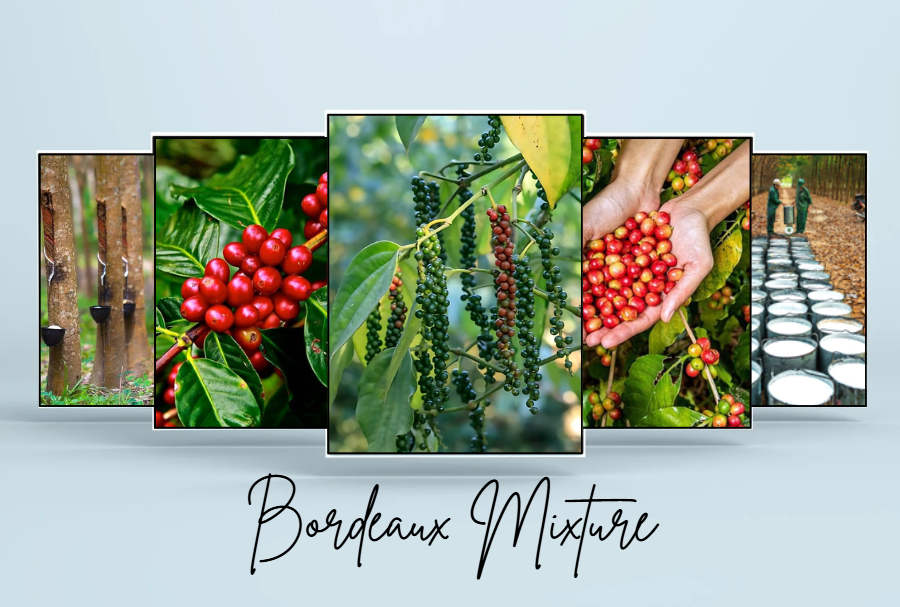
Bordeaux mixture – also known as Boóc-đô – is a classic fungicide originating from France, made from copper sulfate (CuSO₄) and hydrated lime (Ca(OH)₂). With its contact action, broad spectrum, and eco-friendly nature, Bordeaux mixture has long been applied in many crops.
But when it comes to long-term industrial crops like pepper, coffee, and rubber, is Bordeaux mixture really effective, and should it be applied? Let’s explore.
1. Advantages of Using Bordeaux Mixture on Industrial Crops
✅ Broad-spectrum activity
- Controls many common fungal pathogens: Colletotrichum spp., Cercospora spp., Phytophthora spp., Oidium spp.
- Effective against leaf spot, blight, anthracnose, rust, powdery mildew—frequent in pepper, coffee, and rubber.
✅ Low risk of resistance
- Being inorganic, Bordeaux mixture does not trigger resistance mechanisms like systemic fungicides do → suitable for long-term, rotational use.
✅ Accepted in organic farming
- Approved by many international organic standards due to its mineral-based composition and low toxic residues when used properly.
✅ Affordable and easy to prepare
- Ideal for smallholders or as a cost-saving solution in rainy, humid seasons when fungal diseases spread rapidly.
2. Specific Applications by Crop

🌿 On Pepper (Piper nigrum)
|
Target Diseases |
Usage Notes |
|
Leaf spot, blight |
Spray regularly at the start of rainy season |
|
Anthracnose, rust |
Effective when applied early |
⚠️ Note: Not effective against root diseases such as Phytophthora capsici (quick wilt). For these, use soil-applied fungicides like Fosetyl-Al or Metalaxyl.
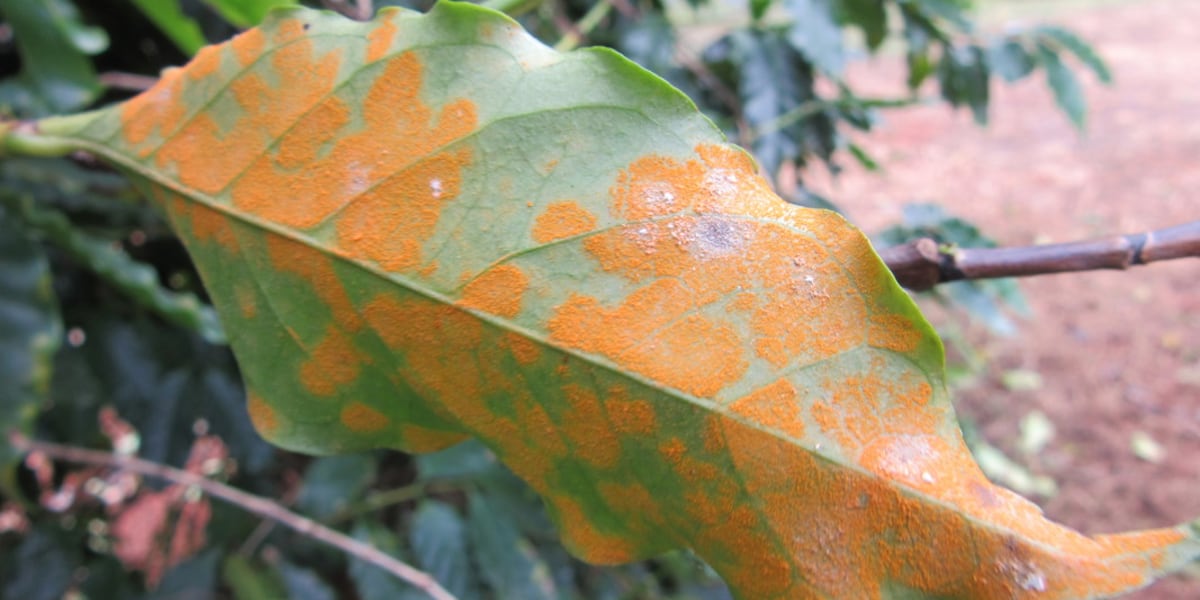
☕ On Coffee (Coffea spp.)
|
Target Diseases |
Effectiveness |
|
Coffee leaf rust |
Prevents well at early stages |
|
Leaf spot, anthracnose |
Helps prevent spread |
📌 Tip: Apply Bordeaux mixture at the end of dry season or early rainy season to reduce disease outbreaks when humidity increases.
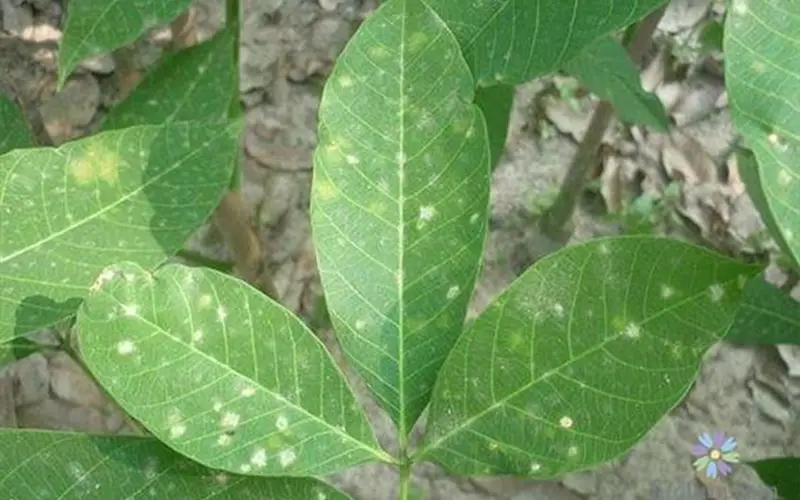
🌳 On Rubber (Hevea brasiliensis)
|
Target Diseases |
Application Timing |
|
Powdery mildew (Oidium) |
When trees flush new shoots/leaves |
|
Leaf spot, early leaf fall |
During seasonal transitions |
⚠️ Note: Do not spray Bordeaux mixture when rubber trees are being tapped or have fresh latex wounds, to avoid tissue damage.
3. Limitations to Consider
|
Limitation |
Solution |
|
No systemic action, cannot cure |
Use preventively; apply before heavy infection |
|
Risk of leaf burn if mixed wrongly |
Follow ratio (1:1:100); avoid spraying under hot sun |
|
May cause blue stains on fruits |
Avoid spraying near harvest |
|
Incompatible with strong alkaline products |
Apply separately or alternate spraying |
4. Should Bordeaux Mixture Be Used on These Crops?

👉 YES – if you need:
- A low-cost, eco-friendly preventive fungicide
- A rotational tool in integrated pest management (IPM)
- A product accepted in organic farming and compatible with export standards (VietGAP, GlobalGAP)

👉 NO – if:
- The crop is already heavily infected and needs systemic fungicides
- The disease affects roots or internal tissues (quick wilt, root rot, vascular wilt)
5. Conclusion
Bordeaux mixture can be effectively used on pepper, coffee, and rubber, especially for preventing foliar fungal diseases during humid and rainy seasons.
When combined with good agronomic practices (field sanitation, crop rotation, balanced fertilization, and fungicide rotation), Bordeaux mixture helps maintain healthy, productive, and sustainable plantations.
👉 In short: Bordeaux mixture is not a cure-all but remains a valuable, reliable preventive tool for industrial crops.


Leave a comment