

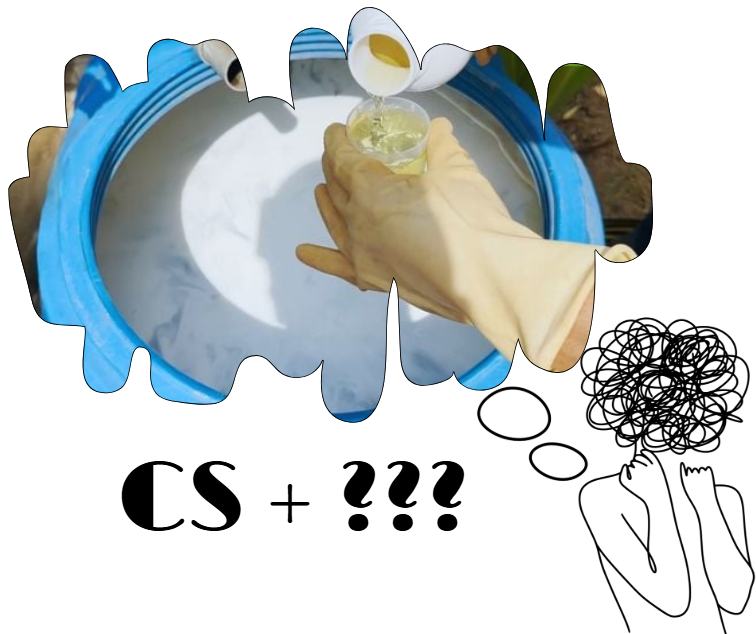
In practice, many farmers often mix several products into one spray tank—pesticides, foliar fertilizers, bio-products, and mineral oils—to save labor and time. However, when using microencapsulated formulations (CS – Capsule Suspension), mixing is not as straightforward as with EC, SC, or WP formulations.
So, can CS formulations be mixed? If yes, how should they be mixed without damaging the capsules, reducing effectiveness, or even causing phytotoxicity (leaf burn)? Let’s break it down.
⚗️ 1. Can CS Formulations Be Mixed?

Yes – but only if done correctly.
CS formulations are microencapsulated suspensions, where the active ingredient is enclosed in tiny polymer capsules. If mixed with strong acids, alkalis, or organic solvents, these capsules may rupture, leading to:
- Early release of the active ingredient → loss of slow-release benefit
- Sediment at the bottom of the tank → nozzle blockage
- Reduced effectiveness, or unwanted chemical reactions
❗ 2. When NOT to Mix CS Formulations
|
Case |
Potential Risk |
|
Mixing with strong organic solvents (EC, ME, etc.) |
Capsule wall dissolves → premature release |
|
Mixing with bio-fertilizers, Trichoderma, EM |
Beneficial microbes may be killed / degraded |
|
Mixing with products of pH < 5 or > 8 |
Capsule structure destroyed → loss of effect |
|
Mixing more than 3 products at once |
High chance of uncontrolled chemical interactions |
|
No compatibility test before mixing |
Risk of leaf burn, sediment, or reduced efficacy |
✅ 3. When Mixing May Be Safe (Under Conditions)
|
Product group |
Conditions for safe mixing |
|
Mineral oils, silicone, spreader-stickers |
Compatibility test required, use low dose only |
|
Micronutrient foliar fertilizers |
Must be neutral (pH ~6.5–7), non-corrosive |
|
Other pesticides |
Preferably SC or WP types; avoid EC unless compatibility is known |
|
Root-protecting bio-products |
Do not mix directly – apply separately (1–2 days apart) |
📌 Tip: If you must mix multiple products, first test with 1 liter of solution. If you see oil layers, clumps, or precipitates → do NOT use.
🧪 4. How to Test Compatibility Before Mixing

- Prepare a 1-liter plastic bottle and mix products in the correct proportions.
- Shake well, then leave it for 30–60 minutes.
- Observe:
- 👉 Lots of bubbles, sediment, discoloration, or heat → DO NOT MIX
- 👉 Stable, uniform, no change → likely safe to mix
📋 5. Guidelines for Mixing CS Formulations Properly
- Shake the CS bottle thoroughly before mixing
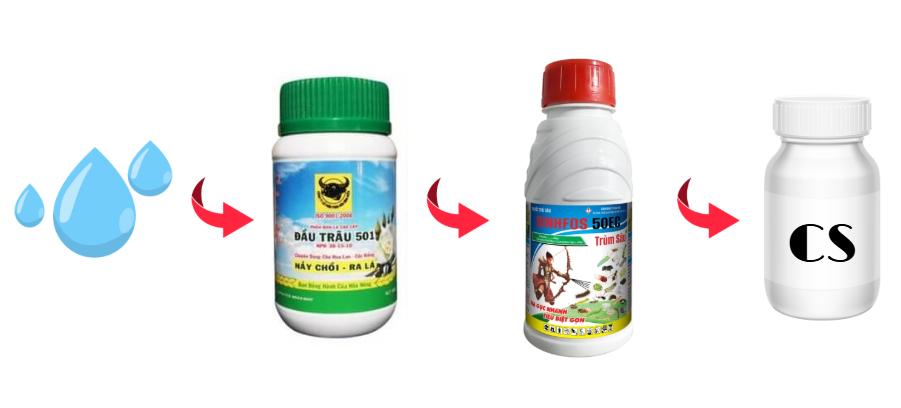
- Mixing order: clean water → foliar fertilizer → insecticide → CS formulation (last)
- Avoid using iron-rich well water or stagnant pond water (can destabilize capsules)
- Use immediately after mixing – do not leave overnight
- Do not spray at midday under hot sun
📌 Conclusion
CS formulations can be mixed, but only if farmers understand the proper techniques to avoid wasting money and reducing crop protection.
✅ Choose neutral, compatible products
✅ Always run a compatibility test first
✅ Keep bio-products like Trichoderma or EM separate from CS sprays
✅ Follow the right order and timing to protect capsule integrity
💬 If unsure about a specific CS product’s mixability, always consult an agronomist or authorized distributor for accurate guidance.


Leave a comment