

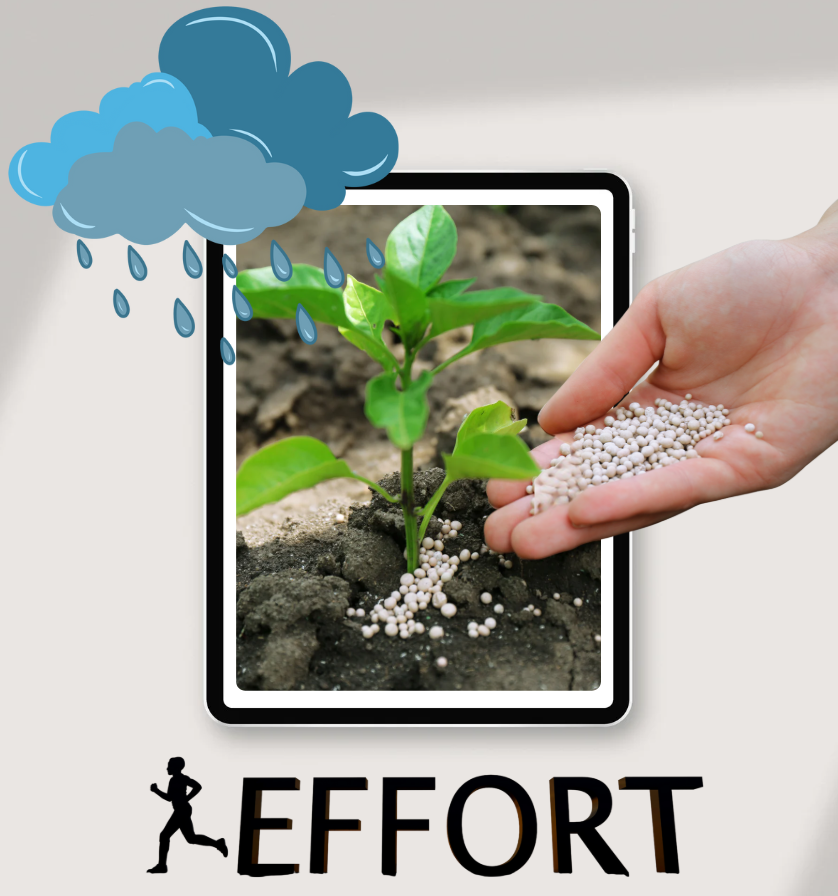
The rainy season makes fertilizing crops challenging. Nutrients wash away easily, soil stays wet for long periods, and farmers must constantly watch the weather before applying fertilizer.
However, with the right timing, fertilizer choice, and technique, farmers can save 20–40% fertilizer & labor costs while keeping crops healthy and productive.
⚠️ Risks of Improper Fertilization During Rainy Season
- Fertilizer dissolves and washes away → wasted nutrients, excess nitrogen in soil → fungal outbreaks
- Waterlogged soil → weak roots, poor nutrient absorption
- Hard to work in muddy fields → high labor cost, slow operations
- Waste of fertilizer without yield improvement
⛔ Many farmers fertilize the same as in dry season → waste + increased diseases + slower growth.
✅ Solution: Less But Better — 3 Key Techniques
1. Apply fertilizer at the right time — small doses but targeted
- Apply before light rain or 1–2 days after rain, when soil is moist but not waterlogged
- Avoid fertilizing when soil is flooded — roots cannot absorb nutrients
- For long-term crops (coffee, pepper, fruit trees): split fertilizer into 2–3 applications instead of one heavy dose like in dry season

2. Combine organic & microbial fertilizers for better efficiency
Use:
- Well-decomposed organic manure
- Compost + biological manure
Add:
- Trichoderma, EM, Humic Acid to:
- Improve root nutrient uptake
- Reduce root fungal diseases
- Improve soil structure and moisture retention
📌 When using organic + microbial fertilizers properly, reduce chemical fertilizers by 20–30%.

3. Choose the right fertilizer — easy absorption, slow-release
- Prioritize slow-release fertilizers, pellet granules, potassium-calcium foliar sprays
- Avoid high nitrogen → soft tissues = more fungal disease risk
- Apply granules away from base of the trunk and lightly cover with soil
🌿 Suggested Rainy-Season Fertilization Schedule
(for coffee, pepper, fruit orchards)
|
Stage |
Recommendation |
|
After fruit set |
Foliar spray rich in K + B + Ca (hold fruits, prevent cracking) |
|
Mid rainy season |
Organic manure + Trichoderma + small portion of slow-release NPK |
|
Late rainy season |
Increase potassium + calcium, reduce nitrogen |
|
End of rainy season |
Prune branches, fertilize to prepare for next crop cycle |
🧪 Recommended Inputs for Rainy Season
|
Product |
Type |
Main benefit |
|
Trichoderma |
Biological |
Improves soil, suppresses root fungi |
|
Humic Acid |
Organic |
Retains water & nutrients, stimulates roots |
|
Slow-release NPK |
Chemical |
Reduces leaching, saves labor |
|
Processed poultry manure |
Organic |
Natural N–P source, improves soil fertility |
📌 Conclusion
“You don’t need more fertilizer — you need correct fertilizer timing and method.”
During rainy season, reducing fertilizer and labor is absolutely achievable if farmers:
✅ Time fertilizer applications properly
✅ Combine organic + biological + slow-release fertilizers
✅ Avoid excess nitrogen & strengthen plant immunity


Leave a comment