

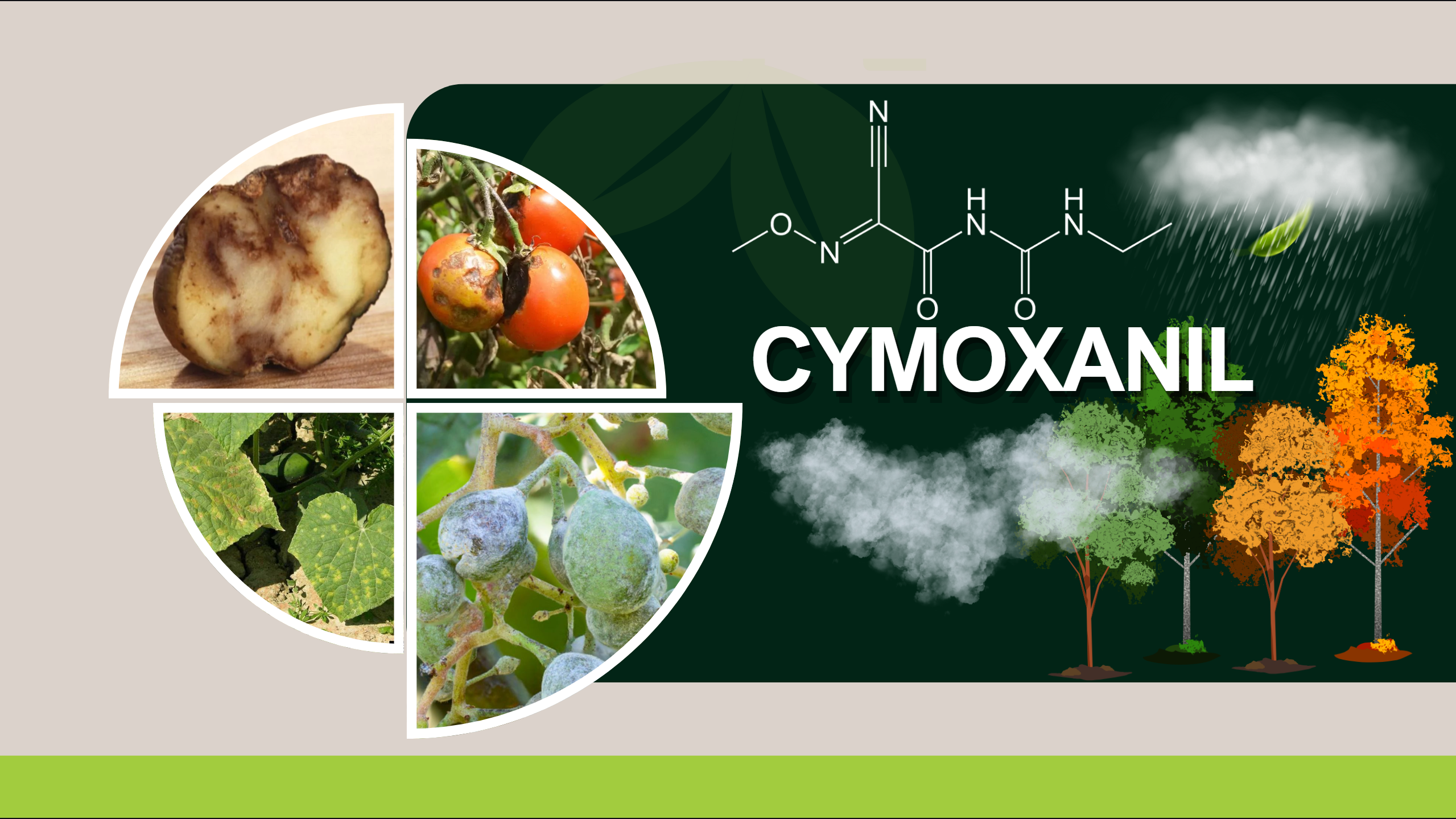
I. Why Pay Attention to Cymoxanil During the Last Three Months of the Year?
In agricultural production, October, November, and December can be an important period for monitoring diseases caused by oomycetes, depending on the region, cropping season, and weather conditions. Rainfall, high humidity, prolonged leaf wetness, and dense crop canopies may create favorable conditions for diseases such as downy mildew, late blight, and diseases caused by Phytophthora.
II. Chemical Structure and Characteristics of Cymoxanil
Cymoxanil is a plant-protection active ingredient belonging to the Cyanoacetamide Oxime chemical group.
The chemical name of Cymoxanil is:
2-cyano-N-[(ethylamino)carbonyl]-2-(methoxyimino)acetamide
Some basic chemical information includes:
|
Characteristic |
Information |
|
Active ingredient |
Cymoxanil |
|
CAS Number |
57966-95-7 |
|
Chemical group |
Cyanoacetamide Oxime |
|
FRAC Group |
U27 |
|
Molecular formula |
C₇H₁₀N₄O₃ |
|
Molecular weight |
198.18 g/mol |
|
Physical state |
Solid |
|
Melting point |
Approximately 159–160°C |
These chemical parameters are reported in regulatory information concerning Cymoxanil.
Important Characteristics of Cymoxanil
One important characteristic of Cymoxanil is that it should not simply be regarded as a conventional contact fungicide.
Cymoxanil can penetrate plant tissues and act at infection sites, which is why it is commonly incorporated into disease-management programs targeting oomycetes, with the objective of protecting newly developing tissues and helping suppress early infections.
However, actual field performance depends on many factors, including:
- Crop type.
- Disease-causing organism.
- Disease development stage.
- Weather conditions.
- Cymoxanil concentration in the product.
- Formulation.
- Co-formulants or companion active ingredients.
- Application rate and timing.
- Spray coverage of the crop canopy.
Therefore, the effectiveness of Cymoxanil should not be evaluated based solely on the active ingredient name. The complete product formulation and its registered label directions must also be considered.
III. Mode of Action of Cymoxanil
Cymoxanil belongs to FRAC Group U27. According to FRAC, its specific biochemical mode of action at the molecular level has not yet been fully determined.
This is an important consideration when developing fungicide-management programs.
Cymoxanil is generally recognized for relatively rapid activity against certain stages of oomycete development, particularly when it is used preventively or at an early stage of disease development.
The application process can be generally illustrated as:
Fungicide application → active ingredient contacts/penetrates plant tissue → interference with the development of the disease-causing organism
Under suitable conditions, Cymoxanil can help:
- Suppress the development of disease-causing organisms.
- Support early disease management.
- Protect healthy plant tissue.
- Limit further disease development on the crop canopy.
However, Cymoxanil should not be reserved until the disease has become severe.
This is particularly important when managing downy mildew and diseases caused by Phytophthora.
FRAC recommends incorporating Cymoxanil into disease-management programs with another fungicide that is effective against the target disease, using it primarily as part of preventive disease management and limiting the number of applications.
IV. What Pests or Pathogens Can Cymoxanil Control?
Cymoxanil is primarily used to manage diseases caused by oomycetes, a group of organisms commonly referred to as "water molds" or "fungus-like organisms."
Important target pathogens include:
1. Phytophthora infestans
This is the pathogen responsible for late blight on:
- Potatoes.
- Tomatoes.
Late blight is one of the most important target diseases associated with Cymoxanil.
2. Plasmopara viticola
This pathogen causes downy mildew of grapes.
The disease can develop rapidly under conditions of high humidity and prolonged leaf wetness.
Cymoxanil is one of the active ingredients used to manage this disease. However, resistance management and fungicide rotation remain important because reduced sensitivity to Cymoxanil has been reported in some populations of P. viticola.
3. Pseudoperonospora cubensis
This is the pathogen responsible for downy mildew of cucurbit crops, including:
- Cucumbers.
- Watermelons.
- Melons.
- Squash.
- Other cucurbit crops.
Cymoxanil has been included in disease-management programs for downy mildew on cucurbit crops in various regulatory and technical references.
4. Other Downy Mildew Diseases
Cymoxanil is also included in disease-management programs for downy mildew affecting several crops, including vegetables, beans, onions, and other crops.
Important: The list above describes the technical use of the active ingredient for reference purposes. For actual use in Vietnam, users must follow the registered product label, including the registered crop, target pest/pathogen, application rate, application method, and pre-harvest interval.
V. Which Crops Are Suitable for Cymoxanil?
It should not be assumed that all crops can be treated with Cymoxanil at the same rate.
Crop groups commonly associated with Cymoxanil use in international technical references include:
Solanaceous Crops
- Tomatoes.
- Potatoes.
These crops are particularly important because of the risk of Phytophthora infestans.
Cucurbit Crops
- Cucumbers.
- Watermelons.
- Melons.
- Squash.
- Other cucurbit crops.
Grapes
Cymoxanil is used for the management of Plasmopara viticola, the causal agent of grape downy mildew.
Other Vegetable Crops
Cymoxanil is also associated with the management of downy mildew in crops such as:
- Beans.
- Lettuce.
- Onions.
- Spinach.
- Leeks.
- Other vegetable crops.
Why Should Farmers Pay Attention During October–December?
In agricultural production in Vietnam, October to December may coincide with weather conditions that favor disease development in certain production areas, especially when the following conditions occur:
Rain + high humidity + prolonged leaf wetness + dense canopy = increased disease risk.
However, weather conditions are not the same in every region.
Therefore, instead of following a rigid schedule such as "October means spray Cymoxanil," growers should consider:
- Weather conditions.
- Disease history in the field or orchard.
- Crop growth stage.
- Disease incidence and severity.
- Rainfall and humidity forecasts.
- Registered product label directions.
VI. Comparison Between Cymoxanil and Other Similar Active Ingredients
Cymoxanil is often considered alongside other active ingredients used to manage oomycete diseases, such as Metalaxyl/Mefenoxam, Dimethomorph, and Mandipropamid.
|
Active Ingredient |
FRAC Group |
Mode-of-Action Group |
Key Characteristics |
Important Considerations |
|
Cymoxanil |
U27 |
Cyanoacetamide Oxime |
Relatively rapid activity; suitable for disease-management programs targeting downy mildew and late blight |
Resistance management is important; avoid overuse |
|
Metalaxyl/Mefenoxam |
4 |
Phenylamide |
High activity against certain oomycetes |
Resistance has been widely reported |
|
Dimethomorph |
40 |
CAA |
Active against oomycetes and affects cell-wall formation processes |
Requires rotation with different modes of action |
|
Mandipropamid |
40 |
CAA |
Highly targeted activity against many oomycetes |
Should not be considered an ideal rotation partner with other Group 40 fungicides |
FRAC classifies Cymoxanil as Group U27, while Dimethomorph and Mandipropamid belong to Group 40. Active ingredients within the same FRAC group may have a risk of cross-resistance. Therefore, simply changing to another active ingredient within the same mode-of-action group is not necessarily an effective resistance-management strategy.
Metalaxyl/Mefenoxam is a notable example of resistance concerns. Reduced sensitivity or resistance to these active ingredients has been reported in various oomycete populations.
Advantages of Cymoxanil
The main characteristics of Cymoxanil can be summarized as follows:
- Relatively rapid activity.
- Suitable for managing diseases caused by oomycetes.
- Can be incorporated into programs with other active ingredients.
- Provides a different mode of action from some commonly used groups such as Phenylamides and CAA fungicides, which can be useful when designing resistance-management programs.
- Can provide good value when used at an early stage of disease development.
Limitations of Cymoxanil
However, Cymoxanil also has important limitations:
- It is not a "universal fungicide" for all fungal diseases.
- Continuous repeated applications should be avoided.
- Resistance may develop when the active ingredient is misused.
- Performance depends strongly on application timing and disease conditions.
- Application rate must be based on the specific registered product and label.
- Increasing the rate without authorization should not be used as a way to obtain "faster" disease control.
FRAC considers the resistance risk for Cymoxanil to be low to medium, while reduced sensitivity has been reported in Plasmopara viticola. Therefore, resistance management remains an important consideration.
VII. Can Cymoxanil Be Tank-Mixed with Other Active Ingredients to Improve Disease Control?
Yes, it can, and this is an important approach in disease-management programs.
However, it is important to distinguish between:
"a technically justified tank mix"
and
"mixing as many active ingredients as possible."
These are completely different approaches.
1. Why Combine Cymoxanil with Other Active Ingredients?
A Cymoxanil-containing product combined with another suitable active ingredient may provide broader or more robust disease management than Cymoxanil alone, depending on the target disease and product formulation.
Cymoxanil may be formulated or used with active ingredients from different groups, depending on the registered product.
Some active ingredients commonly encountered in oomycete-management programs include:
- Mancozeb.
- Copper compounds.
- Dimethomorph.
- Mandipropamid.
- Other registered active ingredients.
However, not every active ingredient should automatically be considered compatible with Cymoxanil.
The following factors should be checked:
- Product label.
- Physical and chemical compatibility.
- Crop.
- Target disease.
- Application rate of each component.
- Pre-harvest interval.
- Risk of crop injury or phytotoxicity.
- Maximum number of applications.
2. Special Attention to Resistance Management
FRAC recommends using Cymoxanil with another fungicide that is effective against the target disease and limiting the number of applications.
A simple resistance-management concept can be illustrated as:
Cymoxanil → different FRAC group → Cymoxanil + compatible partner → rotation among modes of action
rather than:
Cymoxanil → Cymoxanil → Cymoxanil → Cymoxanil
Rotation should be based on the FRAC mode-of-action group, not simply on different product trade names.
VIII. Recommended Cymoxanil Application Rate
This is one of the most important points for pesticide users.
There is no single Cymoxanil application rate that applies to every crop and every product.
Although the active ingredient is Cymoxanil, products may differ in:
- Active ingredient concentration.
- Formulation type.
- Single-active-ingredient formulation.
- Combination formulation.
- Crop.
- Target pest/pathogen.
- Application rate.
- Number of applications.
- Application interval.
- Pre-harvest interval (PHI).
Therefore, application should follow the principle:
Step 1: Correctly Identify the Disease
Do not use Cymoxanil simply because disease-like symptoms appear on the crop.
Determine whether the disease is among the target diseases for which the specific Cymoxanil product is registered.
Step 2: Check the Product Label
Carefully check:
- Cymoxanil concentration.
- Registered crops.
- Registered target diseases.
- Application rate.
- Spray volume.
- Maximum number of applications.
- Application interval.
- Pre-harvest interval (PHI).
Step 3: Do Not Increase the Rate Arbitrarily
Increasing the application rate does not necessarily result in a proportional increase in effectiveness.
Improper use may increase the risk of:
- Phytotoxicity.
- Residues.
- Production costs.
- Selection pressure for resistance.
Step 4: Follow the Maximum Number of Applications
FRAC recommends limiting Cymoxanil applications. Its resistance-management recommendations provide reference limits for different crops; however, these recommendations do not replace the legally registered label directions for products authorized for use in Vietnam.
Practical Principle for October–December
Instead of creating a fixed calendar such as:
October spray → November spray → December spray
a more appropriate program is:
Monitor → identify risk → prevent disease → rotate modes of action → evaluate performance → adjust the program
This approach is more consistent with integrated pest and disease management and fungicide resistance management.
IX. Conclusion and Practical Recommendations
Cymoxanil is a valuable active ingredient for managing diseases caused by oomycetes, particularly diseases such as late blight on potatoes and tomatoes, downy mildew on grapes and cucurbit crops, and certain other diseases affecting vegetables and crops.
FRAC classifies Cymoxanil as Group U27 – Cyanoacetamide Oxime and recommends incorporating it into disease-management programs, using it preventively or at an early stage where appropriate, combining it with another effective fungicide when appropriate, and limiting applications to reduce the risk of resistance development.
During October, November, and December, growers should not view Cymoxanil as a fungicide that must automatically be sprayed according to the calendar. Instead, it should be considered one tool within an integrated disease-management program.
5 Important Principles for Using Cymoxanil
1. Use it for the right disease
Only use Cymoxanil when the target disease falls within the registered use of the specific product.
2. Apply at the right time
Prioritize preventive applications or early disease management when conditions favor disease development. Do not wait until the disease becomes severe.
3. Use the correct rate
Always follow the application rate stated on the label of the registered product.
4. Use appropriate combinations
When tank mixing is appropriate, select compatible active ingredients with different modes of action and ensure that the combination is suitable and registered for the crop and target disease.
5. Follow a resistance-management strategy
Avoid repeated applications of Cymoxanil. Rotate FRAC groups and combine chemical control with cultural practices such as field sanitation, canopy management, drainage improvement, and reducing prolonged leaf wetness.
Cymoxanil Is Not a "Universal Fungicide"
One common mistake in pesticide use is assuming that an active ingredient that performs well against one disease group can be used for all diseases affecting a crop.
Cymoxanil is most effective when it is placed in the appropriate position within an overall disease-management program.
During the final three months of the year, growers should combine:
Weather monitoring + regular field scouting + early disease identification + properly registered fungicides + mode-of-action rotation + cultural practices
to improve disease-management performance, reduce production costs, minimize resistance risks, and contribute to safer and more sustainable agricultural production.


Leave a comment